Is ChatGPT Your Friend or Enemy: You Decide
Comments
It Began With…
“Tell me a dark story about a guy who makes pizza with a twist ending” Those were the first words I ever wrote to ChatGPT. Seriously. I was testing out this “new chat thing” that was supposedly very good. And we were all impressed. I read that story aloud to the friends I was hanging out with that night. We were all so blown away by the details and intrigue it seemed to pull out of thin air in a matter of seconds. My prompts and relationship with ChatGPT have come a long way since then.
It was fun when artificial intelligence was such a mysterious system, that you had to worry about it getting smart enough to take over the world. This idealistic belief in the magic of such a machine helped create great works of art such as The Terminator, The Matrix, and I, Robot, just to name a few.
We’re not here to delve too deep into the inner workings of GPTs, neural networks and decision trees . I should also probably point out (if it’s not super obvious yet) that I am by no means any kind of expert on AI. This post is entirely about my own experiences with the beast. When I say “AI”, I am referring to ChatGPT, Claude or other LLM tools. I don’t use the others much, so they fall outside the purview of this post.
This image has been generated with AI. You’ll have to read the rest of the article to decide if it’s trustworthy.
Let’s all move past "chatting" to building more streamlined workflows. Hopefully the rest of you have also moved on from trying to make it contradict itself, or trying to trick it into giving you advice that is illegal, unethical, or dangerous. AI engineers continually work towards fixing that nonsense anyway. Nobody wants an AI companion that’ll encourage you towards suicide (true story1).
My hope for you is that by the end of this post you’ll have a better understanding of AI’s limitations and abilities, and with that knowledge you’ll be able to continue using AI as an intelligent assistant rather than allowing it to supplant your own cognitive abilities.
How It Works: A Crude Overview
I beg you to forgive this gross oversimplification, but at its core, ChatGPT is a glorified search engine.

AI Snake Oil: What Artificial Intelligence Can Do, What It Can’t, and How to Tell the Difference
Here's a resource if you want to know more about the limitations and abilities of AI. The book explains the topic well without getting too technical.
If you can believe, AI had made further advances in image recognition before it was able to hold a substantial conversation with an average user. This may seem backwards, but all the algorithm needs to do for image recognition is see how each pixel relates to the pixel near it, which isn’t that hard for a program to do (relatively speaking). However, there is an entirely new facet with text and words. The ideas behind words can have other far-reaching meanings. Communication involves many nuances that can be exceedingly difficult for even humans to grasp. (Man, if I had a dollar for every time my wife and I had a miscommunication, I wouldn’t need to work). This is something a program doesn’t have a hope of understanding. And yet, ChatGPT interacts with us with surprising skill in conversations. You have to remember that despite its clever answers to your prompts, ChatGPT is a program that is built on a set of rules. They way it works this: when you ask it a question, it scours the training data for the keywords you used and takes its best guess at what characters should logically follow your prompt. The internet is an absolute black hole of infinite information. Is all of that information accurate? No! We all know that already. Yet, that is where ChatGPT is getting all this vast knowledge that it helpfully feeds back to you. Truthfully, it’s an amazing feat of programming that it is correct as often as it is. ChatGPT doesn’t know the difference between true and false, or honesty and a lie. That is how it was able to fabricate fake cases for a lawyer doing research and tell the lawyer that the cases were real (another true story 2).
It has no malicious intent. It’s just gathering up information that it has access to and giving it to you. It is our automation bias that drives our blind trust in its answers. Not to mention, ChatGPT is scarily good at sounding confident.
Automation Bias
Automation bias is the propensity for humans to favor suggestions from automated decision-making systems and to ignore contradictory information made without automation, even if it is correct.
Why AI Gets It Wrong Sometimes
In my industry of electrical engineering a lot of the problems we face are esoteric. Much of the knowledge that an experienced engineer has is tacit knowledge . So what? That means the answers are not all over the internet. And if the correct answers are not copious on the web, ChatGPT doesn’t necessarily have access to them. So it’s just going to give you its best guess, because, hey, that’s what it was programmed to do. There’s a lot more that goes into the reasoning and programming behind chat bots, but I won’t bore you with the details. I just want you to have a better idea of what’s going on behind the curtain when you ask your genius best friend ChatGPT to help you solve a work problem.
Let’s Get Practical: ChatGPT is a Boss at a Few Things
My latest project with AI is a program for work that helps track CAD tool license usage. For years I’ve been wanting a way to track which licenses get the most use, which ones we can do without. AI helped write the program for this in under a day. Even though AI did 99% of the work, we mere humans can’t help but congratulate ourselves on the use of our brilliant prompts. Without us, this magnificent program couldn’t conceive itself! Much in the same way we feel like kings for our part in helping create our children, though our contribution is literally microscopic.
On the more regular person (non-engineer) side of things, my wife has claimed that ChatGPT has been invaluable for a number of things—from meal planning, to helping create lessons for church kids programs. While these uses for ChatGPT may be uninspired, they are tasks that it handles quite well.
But It Also Needs a Babysitter
Though my little project was a massive success, it was only through multiple attempts that it ended up working the way I wanted. Sometimes it didn’t parse a text file properly and I had to provide more examples before it got the syntax correct. Other times, the aesthetic outcome of the web interface was crude or buggy and I needed to provide more direction.
Another example is how ChatGPT was invaluable in helping my wife create meals and lessons, but in both cases the answer the AI provided was not enough by itself. When she was given a recipe from ChatGPT she didn’t trust that that recipe was going to turn out well. My wife seemed to understand that the AI might not be a skilled chef so after getting suggestions from the AI she would Google the new recipe idea and get real recipes (with reviews) rather than blindly trusting what AI cobbled together. This is for simple mainstream tasks! Don’t get me started on the answers it’ll give for a complicated engineering question.
Oftentimes the lesson idea for the church kids program lacked depth. Or the suggestions start to feel repetitive as it seems that our dear old AI has a certain writing style. This “style” gets more obvious the more you use it for similar tasks.
This makes it glaringly obvious when people use it for absolutely everything. (You know who you are). I’m guessing that you guys don’t know that people who are very familiar with AI can spot its writing style from a mile away (oh hey, em-dash, haven’t seen you in about 3 seconds). Did you really need AI to write that two sentence email response? Truthfully, it’s getting to the point where I appreciate typos because it means a human used their own faculties to reply to me without leaning on AI. Give me a poorly structured genuine human sentence above a repetitive AI one any day! On that note, articles written by AI have no interest for me. AI's stamp on your work shouldn't be the first thing that gets noticed. In fact, it should remain invisible.
Here’s the Rub
Stay with me because this is the important part. You have to know something about the topic you are prompting AI for. At least if you want a quality answer. I know that’s a conundrum. If I already know what I’m doing, why would I need AI?? But that’s the thing: you’ll go ahead and prompt it about a topic you know next to nothing about. It spits out the answer and you can’t tell if it’s correct or not, so you copy/paste exactly as is (don’t do that!) and send off “your” answer. I hate to break it to you, but it doesn’t make AI look incompetent when you do that; it’s a poor reflection on you. Your prompts are not the problem, your baseline knowledge on the topic is.
Image source: https://www.normaltech.ai/p/could-ai-slow-science, an illustration from Kapoor and Narayanan which succinctly describes one particular issue with letting AI do your thinking for you.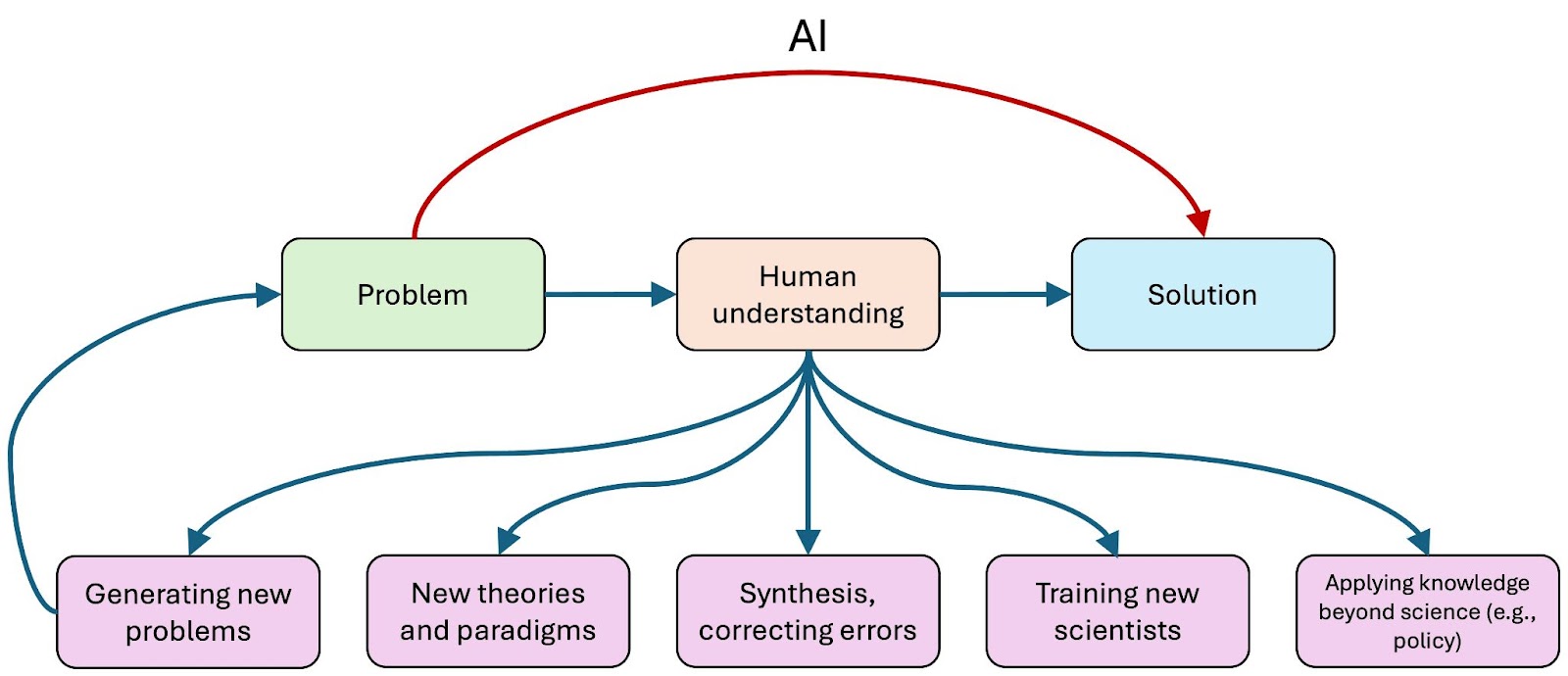
There is a large group of people who misuse AI that are collectively lowering society’s ability and desire to learn something new, because the answers given create the illusion that you got something accomplished when it didn’t even solve your problem of not knowing how to do it in the first place. This is becoming a big problem in schools, too, because kids are cheating to get the answers from AI instead of learning how to do the work. I want to remind you that the complex answers AI is giving you are often wrong. Because who cares if someone uses a program to get the correct answer? Problem is, the answers aren’t even right, I could remain silent if they were. No one cared when we started using calculators to get math answers faster. However, schools required you to learn the basics of math before allowing you to begin using them so….still learning at least.
If you’re using AI in a completely personal aspect, you do you. No one cares if it writes your to-do list or gives you workout ideas. I’m talking about things you will be sending to other people.

Artificial Intelligence: A Guide for Thinking Humans
This book predates AI Chat Bots and is more of a history of what led up to them. Unlike the other book, this one is quite technical.
I’m not trying to make you lose faith in AI but rather have a more realistic idea of what it's capable of. It's feasible that these problems will one day be fixed but in the meantime, vigilance is required to continue monitoring answers for errors and misinformation.
Do This, Not That
People who use AI properly use it to streamline processes they already know how to do, or at least have some knowledge about. AI is your assistant not your professor. Which is why the answers often require a heavy human editing hand. AI is good, it’s just not that good. When you prompt AI about something instead of finding resources and learning how to do it yourself, you leave the same way you came: not any wiser. Back in my day, our only option was learning how to do it. Use AI for the simpler but more tedious tasks, leaving your brilliant mind for the tasks meant for humans.
If you’re about to ask AI a complicated question that you know probably took other people years to learn, my advice instead is to instead ask it for resources that can help you learn about it yourself. I’m going to provide you with some of these resources if you have an interest in electrical engineering or PCB design.
If you're looking for some EE or PCB resources, here are a few of my favorites:
- Henry Ott's Tech Tips (Some EE and PCB topics)
- Henry Ott's Book List (Primarily for EE topics such as SI/PI/EMI)
- Fedevel Academy YouTube (PCB Design)
Get yourself to the level where you can tell when AI's answers are adequate and good enough for the task you need. Or just straight trash and the prompts need to be changed or the task needs to be handed off to a human. This will help you use AI discerningly. I have a deep passion to see knowledge passed on and grown effectively. Especially to those who are truly willing to learn. My friends and children are normally the recipients of this quest and they can tell you how much I value learning. They've learned not to ask simple questions like "why would they even make a $200 calculator?" Can, worms, open. They'll never ask again.

SwissMicros DM42n RPN Calculator
This is the most incredible calculator I've ever used!
Anyway, as a wrap up, I do love talking about all things engineering and I’m always happy to answer any questions. So feel free to reach out. You’ve been warned though about getting more information than you bargained for.