← All writing

S-Parameters from a Neural Network

S-Parameters from a Neural Network

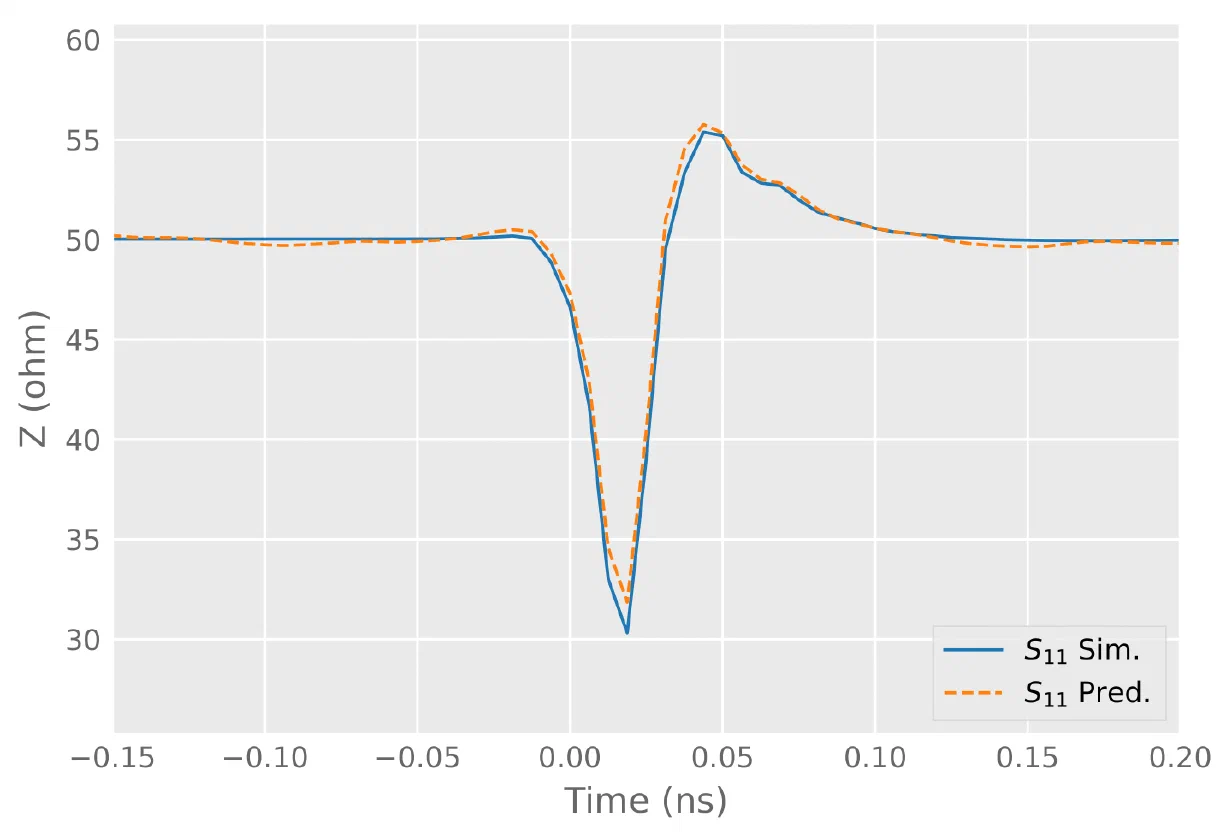
Continuing on the theme of using machine learning to speed up electromagnetic simulations, we've got some new work to share! This paper goes beyond the 2D example previously explored and now looks at full-wave 3D solutions . Most importantly, we wanted to show that this is possible with geometry generalizations. For example, many papers pass things like via drill diameter and other parameters directly as input to their neural networks . We instead mesh the geometry into a 3D rectangular grid and pass this as input to the neural network instead. The result was quite impressive!


TechRxiv Preprint October 08, 2024
A Novel Convolutional Neural Network for Prediction of Scattering Parameters from Three-Dimensional Meshed Geometry
Stephen Newberry, Ata Zadehgol
We propose an artificial intelligence (AI) modeling method that utilizes an arbitrary voxelized mesh of a small PCB via structure, without relying on parametric geometry. Our AI model, based on a multilayer convolutional neural network (CNN), significantly reduces simulation time for small PCB via structures. By employing advanced AI techniques, we enhance the accuracy and quality of predictions while substantially reducing the size of the neural network model compared to our previous work using a fully connected neural network (FCN). The CNN-based model predicts 2-port scattering parameters with a median Huber error of 0.16%, achieving computational speeds over 13,000 times faster than traditional full-wave field solvers.


Update: Published!

I'm proud to announce that the work that Dr. Zadehgol and I did using neural networks to predict S-parameters from 3D meshed geometry has been published at the 2025 IEEE National Radio Science Meeting (USNC-URSI). See the IEEE Xplore pages below for more details.

IEEE Xplore Paper January 07, 2025
An Algorithm for Converting PCB Via Structure to a Voxelized Mesh for Artificial Intelligence Models
Stephen Newberry, Ata Zadehgol
Hardware design for radio frequency devices often demands the use of full-wave electromagnetic (EM) field-solvers to extract scattering parameters (S-parameters) for systems that contain discontinuities throughout their printed circuit boards (PCBs) and substrate packages. Using EM field-solvers not only requires extensive EM knowledge during the setup phase, but also demands considerable computational resources. Previously, machine learning (ML) and neural network (NN) models have been used to solve EM fields; however, they tend to use design parameters as input rather than the structure’s geometry. Parametric analysis is beneficial when the solution space is well bounded, but it is more desirable to develop the capability of feeding generic and arbitrary geometry into a machine learning model for rapid S-parameter extraction. This work presents an algorithm for converting a sub-section of hardware geometry designed with an electronic design automation (EDA) tool into a dataset suitable for training and validating machine learning models including fully connected NNs and convolutional NNs (CNNs).

IEEE Xplore Paper January 07, 2025
Neural Network Prediction of Scattering Parameters Based on Voxel Mesh Representation
Stephen Newberry, Ata Zadehgol
In our work, we demonstrate a novel Neural Network (NN) based methodology for generating S-Parameters based on using the meshed and discretized geometry as input to the NN. Our approach would enable a designer to rapidly optimize the performance of vias across an entire substrate. This performance is possible while also achieving a computational time improvement of approximately double that in other NN-based works.

comments powered by Disqus

Let’s talk hardware.

Have a question about signal integrity, PCB design, or simulation? I’m always happy to talk engineering.