Can Machine Learning Replace Field Solvers?
Comments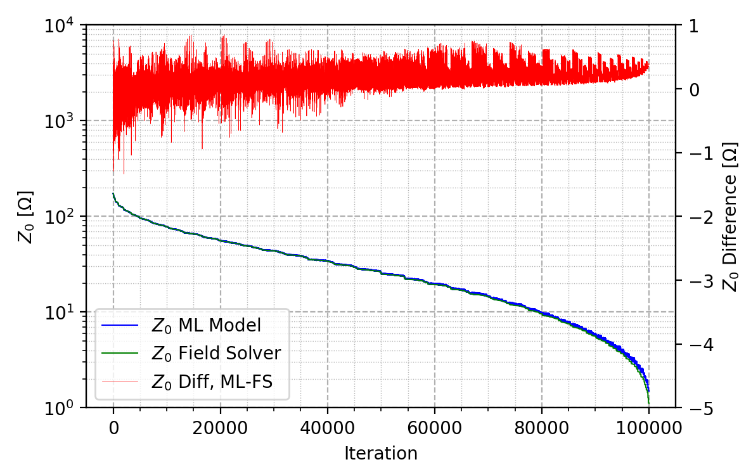
Some initial research points to yes, for certain applications. Here's a preview of a paper I'll be sharing at this year's IEEE EMC + SIPI conference in Spokane. There's still a lot of work to be done, and I'm admittedly quite a machine learning amateur. Even so, I think there are areas in signal integrity where we can find smart ways to apply machine learning to speed up design cycle time.
Update
I'm happy to report that this paper was a Best SIPI Paper finalist at the conference! While I was unable to attend in-person due to a missed flight, the paper has been published to IEEE Xplore here.
A Deep Neural Network Modeling Methodology for Extraction of RLGC Parameters in µ-wave and mm-wave Transmission Lines
Stephen Newberry, Ata Zadehgol
"Transmission line geometry is one of the most critical aspects of high-speed digital and radio frequency (RF) printed circuit board (PCB) design. While relatively simple equation-based methods exist to estimate transmission line parameters such as characteristic impedance, they do not hold accuracy beyond certain structural limitations such as track width to dielectric thickness ratios. Electromagnetic field solvers have become far more common in recent times and can deliver exceptional accuracy with relatively low computational cost. This paper describes a proof-of-concept neural net which utilizes five input parameters of an uncoated microstrip transmission line and is able to output the per-unit-length equivalent resistance, inductance, conductance, and capacitance (RLGC) parameters. The goal of a deep-learning based transmission line tool is to enable accurate microstrip and stripline PCB trace design with computation speeds which allow the engineer to compute hundreds or thousands of iterations in a short period of time with commodity hardware. The final model calculates characteristic impedance with less than ±1.33 Ω error for 100,000 swept samples when the samples are within the middle 90% range of the training data and with a computation speed increase of 14.5 times faster than the benchmark field solver."
Table of Contents
Related Engineering Insights
S-Parameters from a Neural Network
Continuing on the theme of using machine learning to speed up electromagnetic …
PCB Stackup Webinar with Nine Dot Connects
A few months ago, I had the wonderful privilege of presenting a webinar with …
Webinar Recording: 6 Common SI/PI Issues Lurking in Your Design And How to Prevent Them
I recently presented a webinar with EMA Design Automation to explain some …